
Introduction
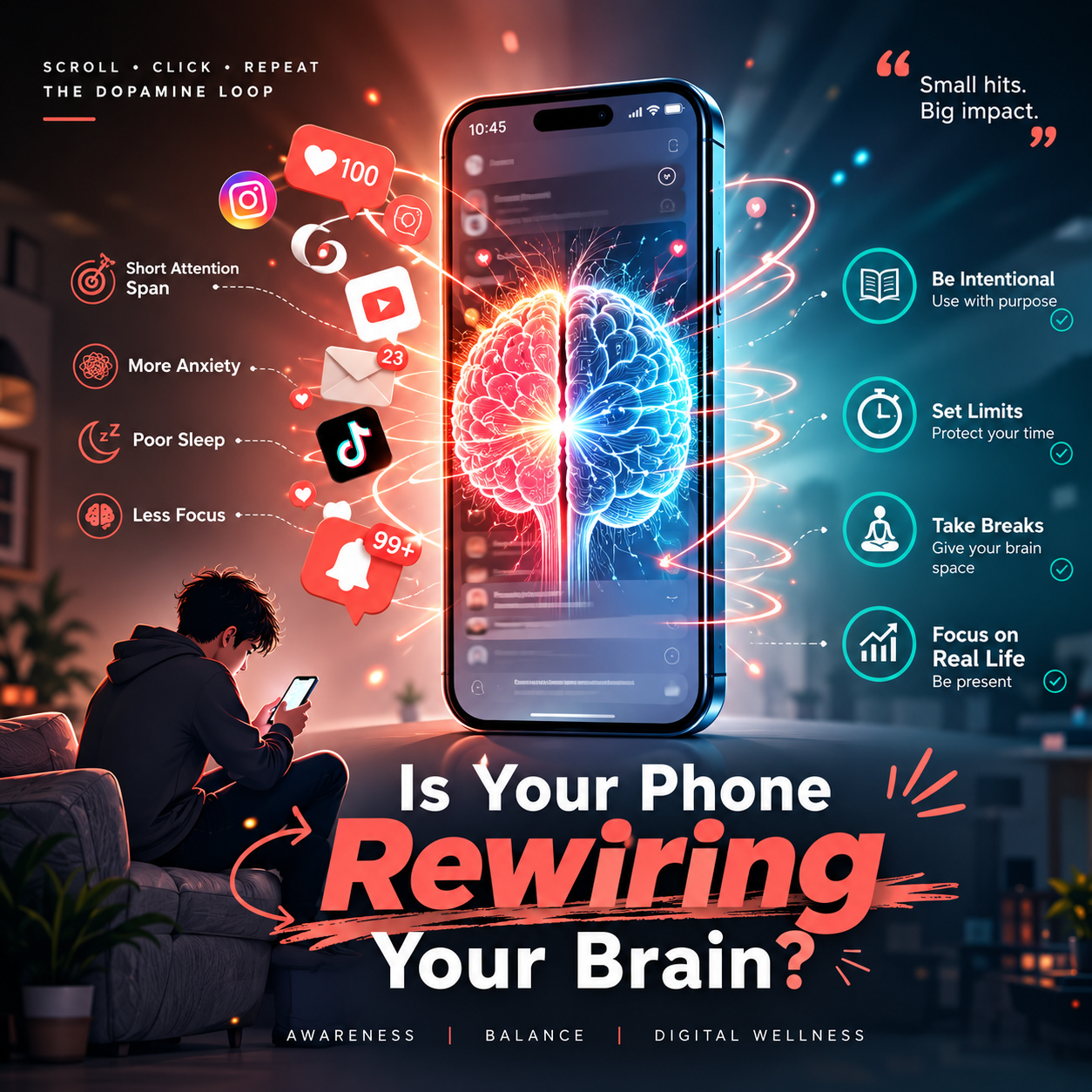
It’s 11 p.m. You told yourself “just five more minutes” of scrolling — an hour ago. Sound familiar? Across the US, the average adult now checks their phone over 140 times a day, and nearly 60% of Americans say they feel “addicted” to their devices, according to recent consumer research. But this isn’t a willpower problem. It’s a neurological one.
Every ping, like, and autoplay video is engineered to hijack your brain’s dopamine system — the same reward pathway involved in eating, exercise, and even substance use. The result? Shrinking attention spans, chronic mental fatigue, and a nagging sense of being “wired but tired.” The good news: understanding why your brain craves the scroll is the first step to reclaiming your focus. This article breaks down the science of screen time and dopamine, and offers realistic, sustainable boundaries — not extreme detoxes — to help you feel sharper, calmer, and more in control.

How Screen Time Hijacks Your Dopamine System
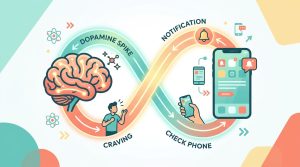
The Dopamine Feedback Loop, Explained
Dopamine isn’t the “pleasure chemical” — it’s the anticipation chemical. It fires right before a reward, not just after, which is why the unpredictability of a notification, a new text, or an unexpected like is so gripping. Neuroscientists call this a “variable reward schedule,” the same mechanism that makes slot machines addictive.
Apps are designed around this principle. Infinite scroll removes any natural stopping point. Autoplay eliminates the pause where you’d normally decide whether to keep watching. Push notifications create artificial urgency. Each of these features taps directly into the brain’s reward circuitry, training you to seek the next hit of stimulation rather than sit with a single task.
Why Your Brain Builds Tolerance
Just like with any repeated stimulus, the brain adapts. Over time, ordinary experiences — a quiet walk, a face-to-face conversation, a printed book — start to feel understimulating compared to the rapid-fire novelty of a feed. This is sometimes called “dopamine desensitization.” Researchers at institutions like Stanford’s Department of Psychiatry have linked heavy, compulsive device use to reduced sensitivity in the brain’s reward pathways, meaning it takes more stimulation to feel the same level of satisfaction.
This tolerance effect explains why so many Americans report feeling restless or bored without their phone in hand, even during downtime that used to feel relaxing.
The Real Cost: Focus, Attention Span, and Mental Fatigue
Shrinking Attention Spans
Multiple studies on digital media consumption suggest the average attention span on a single screen task has dropped significantly over the past two decades, with some researchers estimating it now hovers around 47 seconds before a shift in focus. Constant task-switching — checking Slack, then email, then a text, then back to work — creates what psychologists call “attention residue”: part of your brain stays stuck on the previous task even after you’ve moved on, degrading the quality of your focus on the current one.
Mental Fatigue Is Different From Physical Tiredness
Mental fatigue from screen overuse doesn’t feel like sleepiness — it feels like static. Common symptoms US adults report include:
- Difficulty starting or finishing tasks, even simple ones
- Irritability or a short fuse by mid-afternoon
- “Zoning out” during meetings or conversations
- Feeling mentally drained despite getting adequate sleep
This happens because constant stimulation keeps the brain’s prefrontal cortex — responsible for decision-making and self-control — in a near-constant state of low-grade activation, with little recovery time.
The Sleep and Screen Time Connection
Blue light exposure suppresses melatonin production, but the bigger issue is often cognitive: scrolling before bed keeps the brain in an alert, reward-seeking state right when it should be winding down. This is a major contributor to the “tired but wired” feeling many Americans experience at night, which in turn worsens next-day focus and fatigue — a cycle that feeds itself.

Realistic Boundaries for Healthier Tech Habits
Digital detoxes that demand quitting cold turkey rarely stick. Instead, sustainable change comes from small, specific boundaries that fit real American work and family life.
1. Redesign Your Notification Settings
- Turn off non-essential push notifications (social media, shopping apps, games)
- Keep only calls, texts from close contacts, and calendar alerts active
- Batch-check email and social media at set times (e.g., 9 a.m., 1 p.m., 5 p.m.) instead of reacting all day
2. Create Phone-Free Zones and Times
Choose two or three concrete boundaries rather than an all-day ban:
- No phones at the dinner table — a habit supported by many US family wellness programs for improving both connection and digestion
- Phone-free first 30 minutes after waking — start the day on your own terms, not an app’s
- Charging station outside the bedroom — removes the temptation for late-night scrolling and morning doom-scrolling alike
3. Use “Friction,” Not Just Willpower
Behavioral science shows that adding small amounts of friction reduces mindless use more effectively than relying on discipline alone:
- Move social apps off your home screen into a folder
- Use grayscale mode during work hours to make your phone less visually rewarding
- Log out of apps that don’t need to stay signed in
4. Rebuild Focus With “Boredom Reps”
Give your brain deliberate practice sitting with low stimulation — waiting in line without checking your phone, or a walk without a podcast. Think of it as strength training for your attention span: uncomfortable at first, but it rebuilds your tolerance for single-tasking over a few weeks.
5. Protect One Deep-Focus Block Per Day
Even 45–60 minutes of phone-free, single-task work (a common technique in US productivity circles, often paired with methods like time-blocking) can meaningfully offset a day of fragmented attention.

Conclusion
Constant digital stimulation isn’t a personal failing — it’s a predictable response to technology engineered for engagement. But once you understand how screen time drives dopamine spikes, shortens attention spans, and fuels mental fatigue, you gain real leverage to change the pattern. You don’t need to quit your phone; you need boundaries that work with your American work-life pace, not against it: fewer notifications, defined phone-free zones, and small daily reps of sustained focus.
Ready to reset your relationship with your phone? Start tonight — pick just one boundary from this article (like a charging station outside your bedroom) and commit to it for the next seven days. Your focus, sleep, and mental energy will thank you.