

Introduction
Somewhere between the 10,000-step obsession and the 20-minute HIIT craze, a lot of Americans have landed in the same confusing spot: Is a daily walk actually “exercise,” or do I need to be gasping for air on a Peloton to see real results?
Here’s the truth most fitness content skips over: this isn’t an either/or question. Low-intensity daily movement and high-intensity workouts aren’t competitors — they’re two different tools that talk to your heart, your metabolism, and your nervous system in completely different ways. Lean too hard on one and you leave real health benefits on the table.
This article breaks down exactly what each type of movement does inside your body, backed by how cardiologists and exercise physiologists actually think about it, and gives you a practical, US-lifestyle-friendly framework for combining both — whether you’re commuting in a car-dependent suburb, working a desk job in a downtown office, or squeezing in workouts before the kids wake up.

What Counts as “Daily Movement” vs. “High-Intensity Exercise”?
Before comparing benefits, it helps to define the two camps clearly, because a lot of the confusion in the U.S. fitness conversation comes from lumping them together.
Low-Intensity Daily Movement (NEAT)
This is what exercise physiologists call NEAT — Non-Exercise Activity Thermogenesis. It includes:
- Walking the dog around the block
- Taking the stairs at the office instead of the elevator
- Parking at the far end of the Target lot
- Gardening, light housework, or mowing the lawn
- A casual 20–30 minute walk after dinner
Your heart rate stays in roughly 50–63% of your max — you can hold a full conversation the entire time.
High-Intensity Exercise (Structured, Vigorous Effort)
This includes workouts that push your heart rate into the 70–90%+ of max heart rate zone:
- HIIT (High-Intensity Interval Training) classes like Orangetheory or F45
- Running intervals or tempo runs
- Heavy resistance training with short rest periods
- Spin classes, CrossFit WODs, boxing circuits
You typically can’t hold a conversation — you’re breathing hard, and it’s mentally and physically demanding.
How Each One Affects Cardiovascular Health
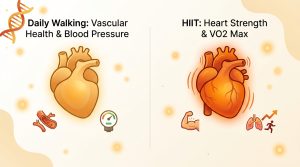
Daily Walking: The Foundation Your Heart Runs On
Regular low-intensity movement primarily improves your resting cardiovascular efficiency. Walking consistently:
- Lowers resting blood pressure over time by improving blood vessel flexibility (endothelial function)
- Reduces triglycerides and improves HDL (“good”) cholesterol
- Keeps blood flowing steadily, which reduces clot risk and vascular inflammation
- Is sustainable enough that most adults can do it daily for decades — consistency is what compounds the benefit
A widely cited body of research associates simply increasing daily step count — even without any structured workout — with meaningfully lower rates of cardiovascular events and all-cause mortality, with benefits appearing well before hitting 10,000 steps.
HIIT and Vigorous Exercise: The Heart’s Stress Test (In a Good Way)
High-intensity training works differently — it’s a controlled stressor that forces adaptation:
- Increases VO2 max (your body’s maximum oxygen-processing capacity), one of the strongest predictors of longevity in clinical research
- Strengthens the heart muscle itself, increasing stroke volume (how much blood is pumped per beat)
- Improves how quickly your heart rate recovers after exertion — a key marker doctors use to assess cardiac fitness
- Delivers cardiovascular benefits in less total weekly time than moderate exercise alone
How Each One Affects Metabolic Health
Daily Movement: Keeping Your Metabolism “On” All Day
This is where NEAT quietly does some of its best work. Every time you stand up, walk to the break room, or take a lap around your office building, your muscles pull glucose out of your bloodstream without needing insulin to work overtime.
- A short 10–15 minute walk after a meal has been shown to blunt post-meal blood sugar spikes significantly — a simple, practical tool for anyone managing insulin resistance or prediabetes, which affects over a third of American adults according to CDC estimates
- Frequent movement throughout the day activates lipoprotein lipase, an enzyme that helps clear fat from the bloodstream — a process that stays suppressed during long periods of sitting, even if you worked out that morning
- This is the “sitting is the new smoking” science: one intense workout does not fully cancel out 9 hours of sedentary desk time
High-Intensity Exercise: The Bigger Metabolic Lever
HIIT and vigorous training pull different metabolic levers:
- Triggers excess post-exercise oxygen consumption (EPOC) — your metabolism stays elevated for hours after the workout ends, sometimes called the “afterburn effect”
- Builds and preserves lean muscle mass, which raises your resting metabolic rate long-term (muscle burns more calories at rest than fat tissue)
- Improves insulin sensitivity dramatically — some research shows HIIT can improve insulin sensitivity in a shorter time frame than steady-state cardio
- Boosts mitochondrial density, essentially upgrading your cells’ capacity to produce energy efficiently
Why You Actually Need Both
Think of it like a financial portfolio. Daily movement is your steady, low-risk index fund — reliable, compounding, low effort, protecting you from the “sitting disease” that dominates American desk-job culture. High-intensity exercise is your higher-growth investment — it requires more effort and recovery, but it produces gains that gentle movement alone can’t replicate, particularly for VO2 max and muscle mass, both of which decline with age if not actively maintained.
Relying only on walking, without ever elevating your heart rate into a challenging zone, leaves cardiovascular ceiling gains and muscle-preserving stimulus on the table. Relying only on 2–3 intense workouts a week, while sitting for the other 23 hours of the day, still leaves you exposed to the metabolic risks of prolonged inactivity — a pattern researchers have specifically studied in the U.S. as the “active couch potato” phenomenon.

A Practical Weekly Framework for US Lifestyles
Here’s a realistic template that fits around a typical American work week:
Daily (non-negotiable, low intensity):
- 7,000–10,000 steps spread through the day
- A 10-minute walk after your largest meal
- Standing or walking during phone calls when possible
2–3x per week (high intensity):
- 20–30 minutes of interval training (running, cycling, rowing, or a class like HIIT/Orangetheory)
- Or 2–3 strength training sessions incorporating compound lifts (squats, deadlifts, presses) with shorter rest periods
1–2x per week (moderate, optional bridge):
- A longer walk, hike, or bike ride at a moderate pace — great for weekends, and a good option for state and national park visits, which many Americans have easy access to regionally
Real-World Example: The Desk-Job American
Consider a 38-year-old marketing manager in a mid-sized U.S. city, working a hybrid schedule. On office days, she takes the stairs to her 4th-floor office, walks to a coffee shop two blocks away at lunch, and parks at the back of the lot. That’s roughly 6,000–7,000 steps of daily movement, done automatically. Three mornings a week, before work, she does a 25-minute HIIT session at home using bodyweight circuits and dumbbells. That combination — consistent daily movement plus focused intensity — checks both the cardiovascular and metabolic boxes without requiring hours at a gym.
Common Mistakes to Avoid
- Treating one intense workout as a “pass” for the rest of the day. Physiologically, it doesn’t fully offset 8+ hours of sitting.
- Doing high intensity every day with no recovery. This raises injury risk and cortisol, and can actually blunt long-term progress.
- Ignoring daily movement because “I already work out.” Structured exercise and daily activity are tracked and rewarded by your body differently.
- All-or-nothing thinking. Missing a workout doesn’t mean the day is wasted — a walk still counts for something real.
Conclusion: Build a Movement Routine, Not Just a Workout Routine
The healthiest approach to cardiovascular and metabolic wellness isn’t choosing between your daily walk and your weekly workout — it’s recognizing that they’re working on different systems in your body, at different intensities, with different long-term payoffs. Daily low-intensity movement keeps your metabolism active and your vascular system flexible hour by hour. High-intensity exercise builds the cardiovascular capacity and muscle mass that protect you decades down the line.
Your next step: Don’t overhaul your entire routine today. Pick one small addition — a 10-minute walk after dinner this week, or one 20-minute interval session — and build from there. Small, consistent shifts in how you move, layered with the right intensity a few times a week, add up to the kind of heart and metabolic health that actually lasts.
What does your current movement routine look like — more walking, more intense workouts, or a mix of both? Share in the comments below, and if this helped clarify things, pass it along to someone who could use the reminder that both types of movement matter.