
Introduction
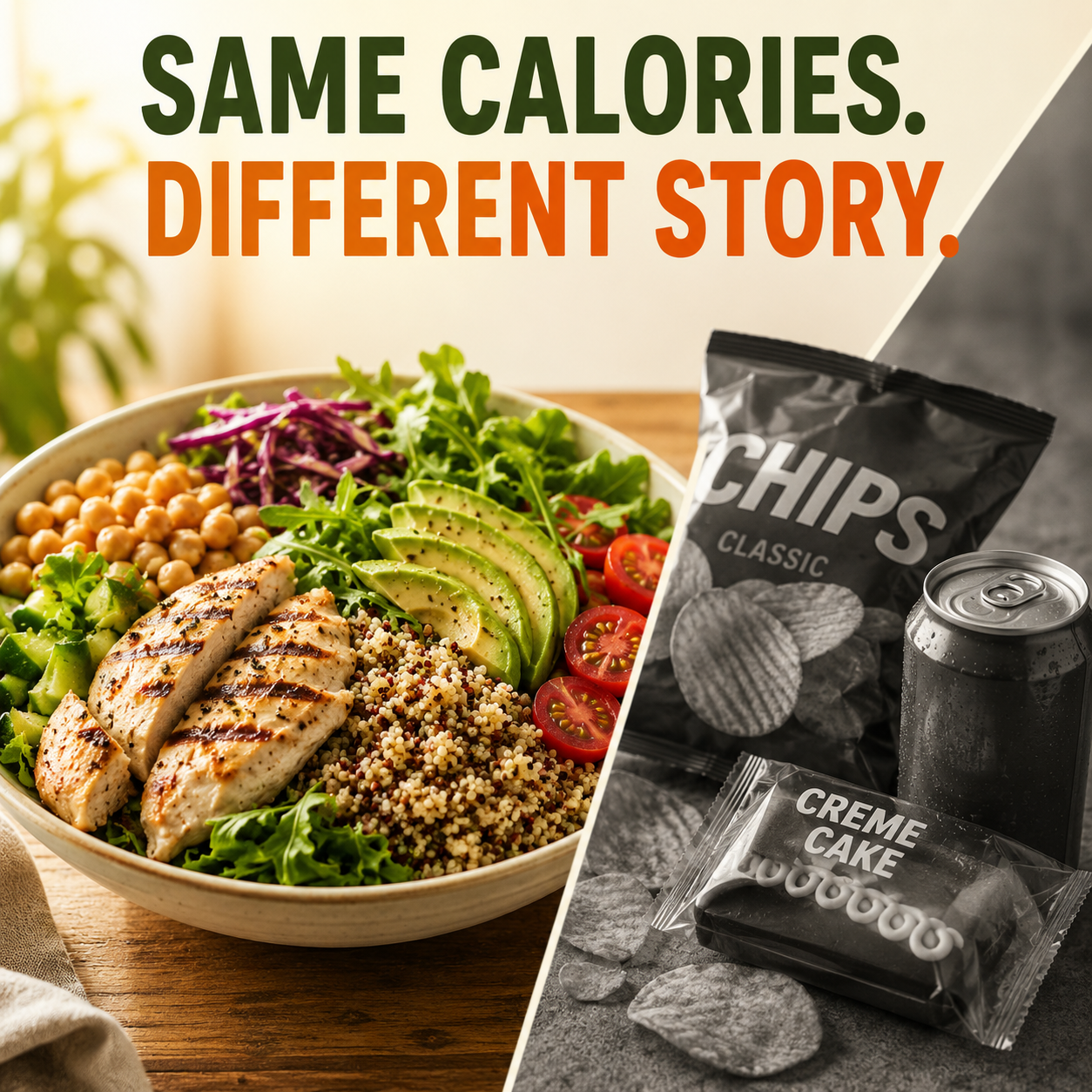
It’s 3 p.m. on a Tuesday. You grab a 200-calorie granola bar from the vending machine at work, and later that evening you eat a 200-calorie serving of roasted sweet potato with olive oil. On paper, your body just received the exact same amount of energy twice. In reality, those two “200 calories” set off completely different chains of events inside you — different hormones, different digestion speeds, different effects on your blood sugar, and even different signals to your brain about whether you’re full.
This is the blind spot in how most Americans have been taught to think about food: as a math equation. Calories in, calories out. But a growing body of nutrition science — including the landmark 2019 NIH metabolic ward study by Dr. Kevin Hall — shows that where your calories come from changes how your body uses them. Understanding the real difference between ultra-processed foods and whole foods isn’t about guilt or restriction. It’s about giving your body what it actually needs to run well.

What “Ultra-Processed” Actually Means (It’s Not Just “Packaged”)
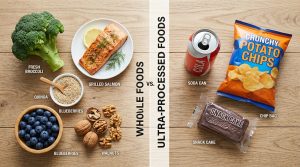
Not all processed food is created equal, and this distinction trips a lot of people up. Freezing vegetables, roasting nuts, or pasteurizing milk are forms of processing — and they’re perfectly healthy. The category that matters for your health is ultra-processed food (UPF), a term defined by the NOVA food classification system used by researchers worldwide.
The Telltale Signs of a UPF
Ultra-processed foods typically share these traits:
- Long ingredient lists with items you wouldn’t find in a home kitchen (maltodextrin, hydrogenated oils, artificial flavor compounds, emulsifiers)
- Industrial formulation, built from refined starches, sugars, fats, and protein isolates rather than intact foods
- Engineered for palatability — hitting precise combinations of salt, sugar, and fat that make them easy to overeat
- Minimal fiber and structure, since the whole-food matrix has been broken down or stripped away
Common American examples include sugary breakfast cereals, packaged snack cakes, most fast-food items, sodas, flavored yogurts with added syrups, and frozen dinners loaded with stabilizers.
What Counts as a Whole Food
Whole foods, by contrast, are minimally altered from their natural state: an apple, a sweet potato, plain oats, a chicken breast, brown rice, or a handful of almonds. What they lack in shelf life, they make up for in nutrient density and structural integrity — the fiber, water, and cellular matrix are still intact.
Why Calorie Counts Don’t Tell the Full Story
This is the heart of the matter. A calorie is a unit of energy, but your body isn’t a furnace that burns everything the same way. Metabolism is a biochemical process, and the form your food arrives in dramatically changes what happens next.
1. The “Food Matrix” Effect
Whole foods have structure — think of the fibrous walls of an almond or the cellular architecture of a piece of broccoli. Your digestive system has to work to break that structure down, which:
- Slows the release of sugar into your bloodstream
- Triggers more sustained fullness hormones (like GLP-1 and PYY)
- Requires more energy just to digest (called the thermic effect of food)
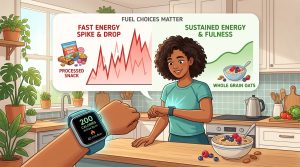
Ultra-processed foods, on the other hand, are often already “pre-digested” by industrial processing. A soft, refined snack requires almost no digestive effort, so sugars and fats hit your bloodstream fast — leading to sharper blood sugar spikes and crashes.
2. The Hall Study: Same Calories, Different Outcomes
In a tightly controlled 2019 NIH study, participants living in a metabolic ward were fed two diets matched for calories, sugar, fat, fiber, and macronutrients — one built from whole foods, one from ultra-processed foods. The result: on the ultra-processed diet, people spontaneously ate about 500 more calories per day and gained weight, while they lost weight on the whole-food diet. Nothing about “willpower” changed. The food itself changed how much people wanted to eat.
3. Fiber Isn’t Just “Extra” — It’s a Metabolic Regulator
Fiber slows gastric emptying, feeds beneficial gut bacteria, and helps regulate insulin response. Most UPFs strip fiber out during processing (a soda has zero; fruit juice has far less than whole fruit), which is a major reason why 200 calories of chips digest so differently than 200 calories of roasted chickpeas.
How This Plays Out in Real American Life
The Grocery Store Gauntlet
Roughly 60% of calories in the average American diet now come from ultra-processed foods, according to nutrition research published in outlets like the American Journal of Clinical Nutrition. Walk into any U.S. supermarket and the aisles are structured against you: whole foods live along the perimeter (produce, dairy, meat), while the center aisles are stacked with shelf-stable UPFs designed to be cheap, convenient, and craveable.
The Convenience Trap
For a busy parent juggling work and a school pickup schedule, a drive-thru meal or a box of mac and cheese isn’t a moral failing — it’s a rational response to limited time. This is why swapping ultra-processed foods for whole foods has to be practical, not aspirational.
Practical Swaps That Actually Work
| Instead of… | Try… |
|---|---|
| Flavored instant oatmeal packets | Plain oats + fresh berries + a drizzle of honey |
| Store-bought granola bars | A small bag of almonds + an apple |
| Sugary breakfast cereal | Plain Greek yogurt + granola + fruit |
| Frozen chicken nuggets | Sheet-pan roasted chicken thighs (batch-cooked) |
| Bottled ranch or Caesar dressing | Olive oil + lemon juice + herbs (2-minute mix) |
| Soda | Sparkling water + a splash of 100% fruit juice |
Reading Labels Like a Pro
A simple rule of thumb nutrition experts often recommend: if the ingredient list reads like a chemistry set, or has more than 5–7 items you don’t recognize, it’s likely ultra-processed. Look for whole-food ingredients listed first, minimal added sugars, and fiber content that hasn’t been engineered away.

It’s Not About Perfection — It’s About the Pattern
No one needs to eliminate every packaged food to be healthy, and treating this as all-or-nothing usually backfires. Whole-grain bread, canned beans, frozen vegetables, and even minimally processed protein bars can absolutely fit into a nourishing diet. The goal isn’t purity — it’s shifting the overall pattern of what fuels most of your meals.
A Simple Framework: The 80/20 Plate
A sustainable approach many registered dietitians recommend:
- Build 80% of your meals around whole or minimally processed foods — vegetables, fruits, whole grains, legumes, and lean proteins.
- Leave room for the 20% — the birthday cake, the weekend pizza, the road-trip snacks — without guilt.
- Prioritize protein and fiber at each meal to naturally crowd out cravings for engineered snack foods.
- Cook in batches on weekends so whole foods are just as convenient as the processed alternative during a busy weeknight.

Conclusion: Feed Your Body, Not Just a Number
The next time you glance at a calorie count, remember it’s only telling you part of the story. A 200-calorie handful of almonds and a 200-calorie snack cake are not metabolic equals — one nourishes, stabilizes, and satisfies; the other spikes, crashes, and leaves you reaching for more. Real nourishment isn’t about hitting a number. It’s about giving your body food it recognizes, can break down efficiently, and can actually use.
You don’t have to overhaul your entire pantry overnight. Start with one swap this week — trade the vending machine bar for a piece of fruit and a handful of nuts, or batch-cook one whole-food dinner you can lean on during a busy weeknight. Small, consistent shifts toward whole foods compound into real, lasting changes in how you feel, think, and function.
Ready to take the next step? Start your own “whole food swap” list this week — pick three ultra-processed staples in your kitchen right now and find their whole-food alternatives. Your body will notice the difference before your mind does.